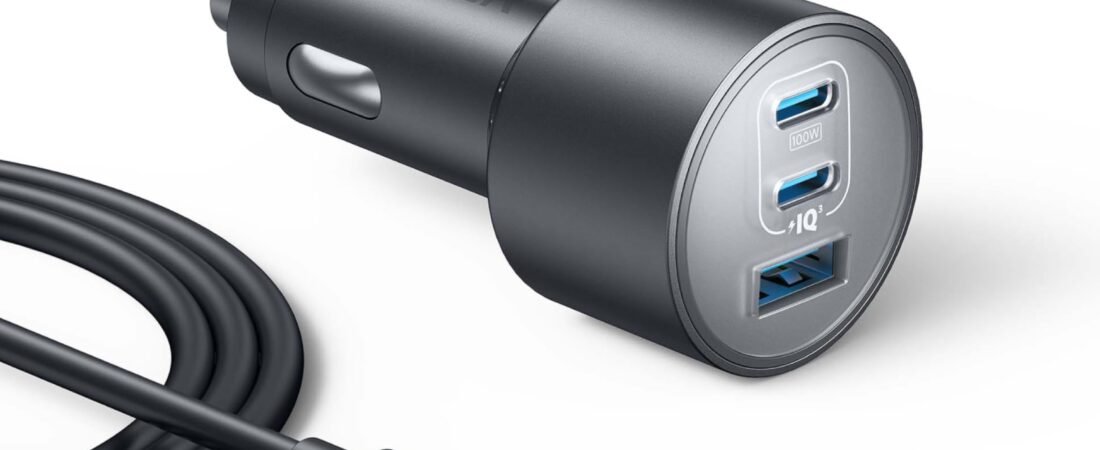
Best USB-C Car Chargers in 2026: 5 Picks for Fast Charging
The best USB-C car charger is not necessarily the one with the biggest wattage number. It is the one that gives your phone, tablet or laptop the power it can actually use — without turning your center console into a cable mess.
For most drivers, 40W–75W is plenty. Laptop users should look higher.
Choose the Anker PowerDrive III Duo if you mainly charge phones and want a simple two-port option. Choose the Anker 167.5W Max if a laptop regularly comes along. If loose cables annoy you every day, a retractable model can be more useful than another 50 watts you may never use.
Compare the best USB-C car chargers Swipe →
These five picks solve slightly different problems. Instead of asking which charger is best in isolation, start with what you actually plug in during a normal drive.

Anker PowerDrive III Duo
Best fit for everyday phone charging when you want two USB-C ports without paying for power you will not use.
Check Price on Amazon ↗Laptop pick
Anker 167.5W Max
Made for drivers who need enough headroom for a USB-C laptop plus phones or tablets.
Check Price on Amazon ↗Cable-free cabin
Anker 75W Retractable
A practical choice when the real problem is a charging cable constantly disappearing under the seat.
Check Price on Amazon ↗Family pick
UGREEN 130W
Better suited to road trips and shared cars where several devices may need power at the same time.
Check Price on Amazon ↗Value retractable
LISEN 63W Retractable
Worth considering when you want the convenience of an integrated cable while keeping the purchase simple.
Check Price on Amazon ↗What matters more than the wattage printed on the box
Shopping for USB-C car chargers gets confusing because manufacturers naturally put the largest number on the front. A 130W or 167W charger sounds dramatically faster than a 40W model, but your phone decides how much power it can accept. Extra capacity becomes useful when you add a laptop, tablet or second passenger — not because it forces a phone to charge beyond its supported rate.
The other detail people miss is power distribution. Total output and output from one specific port are not always the same thing. When two or three devices are connected, the charger may divide its available power. That is why the right question is not simply how many watts it has, but how much power reaches the device you care about when everything you normally use is plugged in.
For modern phones, look for USB-C Power Delivery support and use a cable capable of carrying the required power. If your cable is the weak link, even an excellent charger cannot magically fix it. Our guide to the best USB-C fast charging cables explains that side of the setup in more detail.
Anker PowerDrive III Duo
This is the sensible starting point if your car is mostly charging phones. Two USB-C ports are useful for a passenger or a second device, while the compact format avoids buying a bulky high-output charger simply because the number looks impressive. It is especially appealing for commuters whose drives are short enough that every minute of useful charging matters.
Choose it if: your normal setup is one or two phones and you value simplicity. Skip it if: you expect the same socket to meaningfully power a demanding USB-C laptop.
Anker 167.5W Max
This model makes more sense when the car is part of your workday. A phone does not need this much headroom, but a laptop changes the equation quickly. The extra output also gives a multi-device setup more breathing room instead of making every connected device compete for a small power budget.
Choose it if: you regularly carry a laptop or charge several higher-power devices. Skip it if: the only thing plugged into your car is an iPhone or Galaxy — you would be paying for capability you rarely touch.
Anker 75W Retractable
Sometimes convenience beats specifications. A built-in retractable cable means one less cable to remember, lose or leave tangled around the gear selector. For drivers who charge every day, that tiny reduction in friction can matter more than chasing the highest possible wattage.
Choose it if: you want a charger that is always ready without searching for a cable. Skip it if: you prefer replacing the cable independently whenever it wears out or you frequently switch connector types.
UGREEN 130W
A multi-port charger earns its keep on longer drives. Two USB-C ports plus legacy USB-A support can be more useful for a family than a minimalist charger with a higher single-port number. It also makes sense when your bag contains a mixture of newer and older accessories.
Choose it if: passengers regularly ask for a charging port or your devices use mixed cable types. Skip it if: you drive alone and only need one phone charged.
LISEN 63W Retractable
The appeal here is straightforward: integrated-cable convenience in a lower-power package that is still aimed at everyday phone charging. It is the kind of option that makes sense when cabin organization matters more to you than powering a workstation from the 12V socket.
Choose it if: you mainly charge a phone and like the retractable concept. Skip it if: maximum flexibility, replaceable cables or laptop-class output are priorities.
Match the charger to your real drive, not a spec sheet
Daily commute + phone: start with the PowerDrive III Duo. Work laptop in the car: move up to the 167.5W Max. Messy console: choose a retractable model. Family road trips: prioritize multiple usable ports. That decision tree is more useful than ranking every product from one to five because different drivers are solving different problems.
Before you buy a USB-C car charger
Check the physical space around your 12V socket. Some cars place the socket inside a narrow compartment or beside another control, and a wide charger can become annoying even if its electrical specifications are perfect. Also think about cable length: a short cable may be ideal for a phone mount near the dashboard but frustrating for a passenger in the second row.
Heat is another practical consideration. Cars can become extremely hot when parked, so avoid treating the charger or a connected power bank as something that should sit baking in direct sunlight all day. And if a charger becomes unusually hot, fits loosely in the socket or repeatedly disconnects, stop using it and inspect both the charger and socket.
USB-C car chargers FAQ
Do I need 100W or more for fast phone charging?
No. A phone only draws the power it supports. Higher-output USB-C car chargers become valuable mainly when laptops, tablets or multiple devices enter the picture.
Can a high-wattage USB-C car charger damage my phone?
With a compatible, properly designed USB-C PD charger, the device and charger negotiate the supported power level. Buying more available wattage does not mean the charger simply pushes all of it into the phone.
Why is my phone still charging slowly?
The charger is only one part of the chain. The cable, phone charging protocol, temperature and simultaneous devices can all affect charging speed. If you already own a capable charger, checking the cable is a smart next step.
Buy for the device that changes the equation.
If you only charge phones, a compact dual-port USB-C charger is the sweet spot. A laptop is the reason to spend more for serious wattage; several passengers are the reason to prioritize ports; cable clutter is the reason to choose retractable. Once you identify that one constraint, the choice gets much easier.
Check our everyday pick on Amazon →Paid link. As an Amazon Associate we earn from qualifying purchases.
This article is designed to help you choose based on features, compatibility and use case. Product availability and specifications can change, so confirm current details on the retailer page before purchasing.