A good USB-C cable is still one of the most useful accessories for the iPhone Duo. Magnetic charging is convenient, but wired USB-C remains the better choice when you want stable charging, lower heat and dependable power during travel or heavy use.
This guide to best USB-C cables for iPhone Duo focuses on the differences that matter most before you buy, with practical guidance for choosing the right option for your setup.
How to choose the best USB-C cables for iPhone Duo
- Best everyday cable: 100W braided USB-C to USB-C cable
- Best travel cable: compact 1-meter USB-C cable
- Best desk cable: 2-meter braided USB-C cable
- Best durability pick: reinforced nylon-braided cable
What to Look for in an iPhone Duo USB-C Cable
Look for USB-C Power Delivery support, durable connectors and a length that matches how you actually charge. A short cable works well with power banks, while a longer cable is more comfortable beside a bed or desk.
Do You Need a 100W Cable?
The iPhone Duo will not use the full output of a 100W cable, but higher-rated cables are useful because they can also charge tablets, laptops and other USB-C devices. That makes one good cable more versatile for travel.
Braided vs Standard Rubber Cables
Braided cables are usually a better choice if the cable gets bent, packed into bags or used in the car. Standard rubber cables are lighter and often cheaper, but may show wear sooner with heavy daily use.
Best Cable Length for Travel
A 1-meter cable is the easiest to pack. For hotel rooms and airports, a 2-meter cable can be more convenient when outlets are far from a table or bed.


Final Verdict
For most buyers, a durable 100W-rated braided USB-C cable around 1 to 2 meters long is the safest all-purpose choice for iPhone Duo and other devices.
Affiliate disclosure: Mobile Gear Picks may earn a commission from qualifying purchases when product links are added.
Charging Speed vs Cable Rating
The wattage printed on a USB-C cable is the maximum power it is designed to carry, not the amount the iPhone Duo will automatically draw. A 100W or 140W cable can still be a smart buy because the same cable can serve a phone, tablet and laptop. The charger and connected device negotiate how much power is actually used.
Do You Need USB 3 Data Speeds?
Not every USB-C cable supports fast file transfer. Many inexpensive cables are designed primarily for charging and may use slower data standards. If you regularly move large photo or video files from the iPhone Duo to a computer or external SSD, check the listed data speed before ordering.
For charging only, a slower data cable can still be perfectly useful. The important part is to buy for the job you actually need instead of assuming every USB-C cable does everything equally well.
What an E-Marker Does
Higher-power USB-C cables often include an electronic marker chip that communicates what the cable can safely support. This is especially relevant for higher-wattage laptop charging. You do not need to memorize the technical details, but a clearly rated cable from a reputable brand is preferable to an unbranded cable with vague claims.
Braided vs Rubber Jackets
Braided cables are popular because they resist abrasion and often survive bag use, car use and repeated bending better than thin rubber cables. Rubber cables can be lighter and easier to coil, though. The weak point on almost every cable is near the connector, so reinforced strain relief matters as much as the outer material.
Best Length for Different Situations
A one-meter cable is easy to pack and works well with a power bank. A two-meter cable is more comfortable beside a bed, desk or hotel outlet. Extra-long cables are convenient but can create more clutter, so choose the shortest length that works for your setup.
Travel Setup
For travel, one durable primary cable plus one small backup cable is a sensible combination. If one is damaged or misplaced, you still have a way to charge. Pairing a good cable with a compact GaN charger also reduces the number of separate accessories in your bag.
Car Charging
In a car, a short braided cable is often easier to manage than a two-meter cable hanging around the console. If you use CarPlay or navigation for long drives, choose a cable that fits securely and does not place sideways pressure on the phone connector.
How to Make a Cable Last Longer
Unplug by holding the connector rather than pulling on the cable. Avoid sharp bends near the plug and do not wrap the cable tightly around a charger. These small habits reduce stress on the internal conductors and connector joint.
Buying Checklist
- USB-C to USB-C on both ends.
- Clearly stated power rating.
- Correct length for your use case.
- Data-speed specification if file transfer matters.
- Reinforced connectors and strain relief.
How the two recommended USB-C options differ
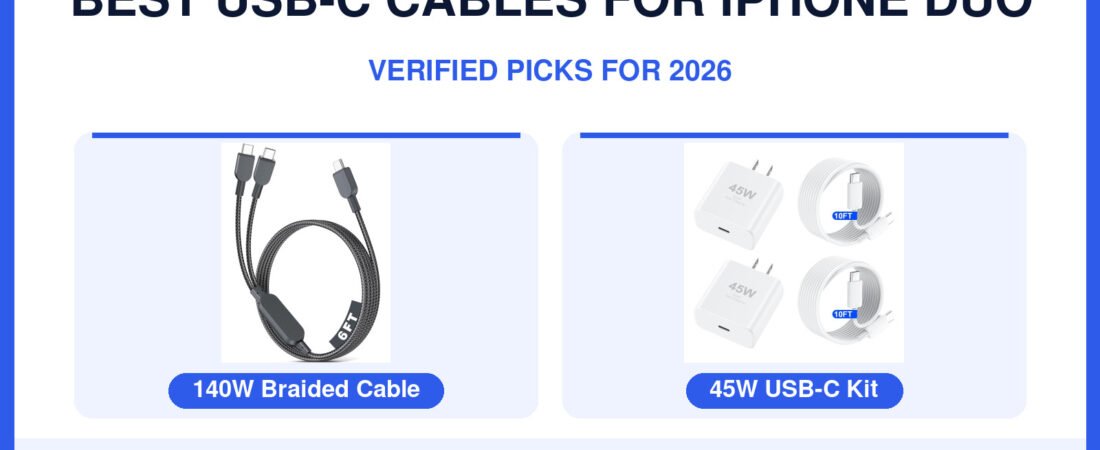
140W Braided USB-C to USB-C Cable
This is the stronger choice if you want one cable that can also serve higher-power USB-C gear. The 140W rating gives it headroom beyond phone charging, which is useful if the same cable may be shared with tablets, power banks or compatible laptops.
The braided jacket is mainly a durability feature, not a speed feature. For daily carry, the real benefit is resistance to abrasion and repeated bending. Charging speed still depends on the phone and charger, so the cable does not force extra power into the iPhone Duo.
- Best for: buyers who want one durable cable for several USB-C devices.
- Watch for: data-transfer speed if you move large files.
- Why it stands out: high power headroom makes it more reusable across a mixed-device setup.
45W USB-C Charger + Cable Kit
This option is aimed at buyers who would rather get the charger and cable together instead of matching parts separately. A bundled setup can be easier for travel, a second desk or a bedside charger because you know you have both pieces in one purchase.
The long cable shown with this kit can also be useful when hotel or bedroom outlets are far from where you actually use the phone. The trade-off is that a bundle is less flexible if you already own a high-quality charger and only need a replacement cable.
- Best for: a complete spare charging setup.
- Watch for: whether the included cable length creates unnecessary clutter in your main setup.
- Why it stands out: convenience is the main value, not maximum charging wattage.
Compare the recommended products
These are the exact Amazon listings selected for this guide. Compare the fit, features and use case that matter most to you before ordering.
140W Braided USB-C Cable
Best for high-wattage USB-C charging and a durable braided build.
45W USB-C Charger + Cable Kit
Best for buyers who want a ready-to-use charger and cable bundle.
Product images and listings are matched to verified Hostinger Affiliate/Amazon data. Prices and availability can change.
FAQ
Can a 140W cable damage an iPhone Duo?
No. With compliant USB-C equipment, the phone draws only the power level it supports.
Does a higher wattage cable charge faster?
Only if the charger and device can use that additional power. A cable rating alone does not increase charging speed.
Should I buy one cable for every device?
Not necessarily. A versatile high-quality cable can work across multiple USB-C devices, which simplifies travel and desk setups.
Bottom line: for most buyers, a durable 100W-rated braided USB-C cable around one to two meters long is the safest all-purpose choice.
As an Amazon Associate, Mobile Gear Picks earns from qualifying purchases.
Care Tips That Make USB-C Cables Last Longer
Avoid pulling a cable out by the wire itself. Grip the connector body, keep sharp bends away from the plug and do not leave the cable crushed under seats or furniture. If a connector becomes loose, damaged or unusually hot, replace it instead of continuing to use it. A small cable organizer can also prevent tight knots in a travel bag.
USB-C Cable Specs That Actually Matter
For the iPhone Duo, the cable does not need an extreme wattage rating to charge the phone, but a 60W or 100W cable is often the smarter purchase because it can also work with tablets, portable batteries and many USB-C laptops. What matters most is build quality, connector fit and whether the cable supports USB Power Delivery correctly.
Charging cables are easy to overlook until one starts disconnecting at the slightest movement. Reinforced strain relief near the connector is one of the most useful durability features. Braided jackets can also help when a cable is frequently packed into bags or used in a car.
Best Length for Different Uses
One meter is the easiest all-purpose size for travel and power banks. Two meters is better beside a bed, sofa or desk. Very long cables can be convenient but add bulk, so it is worth matching length to the actual charging location.
Charging vs Data Transfer
Not every USB-C cable supports the same data speed. If you only charge the Duo, a charging-focused cable is fine. If you plan to transfer large videos, photos or backups to a computer, check the listed USB data specification separately because high charging wattage does not automatically mean high transfer speed.
Buying Checklist
- USB-C to USB-C connector type.
- At least 60W rating for broad device compatibility.
- Reinforced connector ends.
- Length that matches travel, car or desk use.
- Clear data-speed specification if file transfers matter.
FAQ
Will a 100W cable force too much power into the iPhone Duo?
No. The phone and charger negotiate the power level. The cable rating simply indicates the amount of power the cable is designed to carry safely.
Do braided cables charge faster?
Not by themselves. Braiding mainly affects durability. Charging speed depends on the charger, phone and cable specification together.