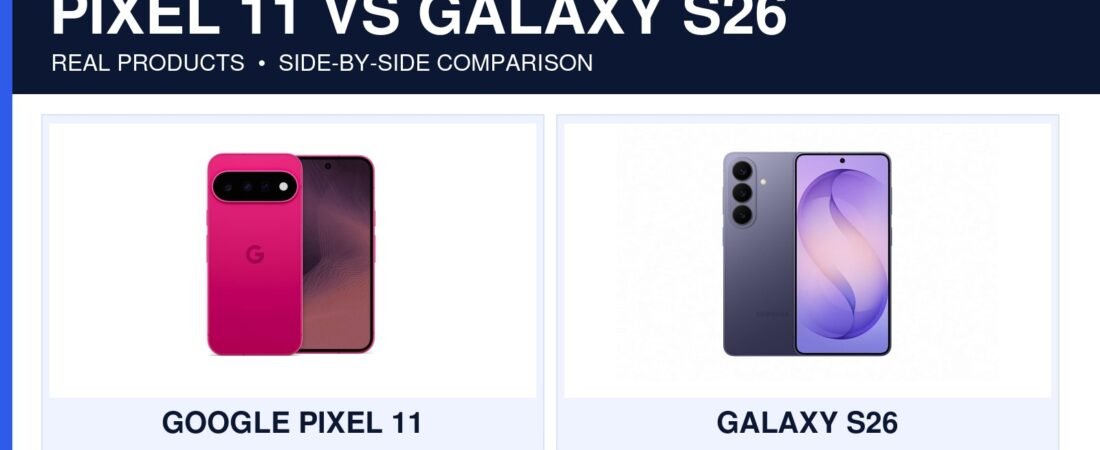
Updated August 2026
Pixel 11 vs Galaxy S26: Which Android Flagship Should You Buy?
The Pixel 11 vs Galaxy S26 decision comes down to a simple trade-off: Google’s newest AI-first Pixel experience versus Samsung’s polished, compact flagship with a proven telephoto camera.
Choose the Pixel 11 if you want Google’s newest Tensor G6 platform, Pixel-first AI features and camera software. Choose the Galaxy S26 if you care more about a dedicated 3x optical zoom, Samsung’s mature ecosystem and a very light 6.3-inch flagship.
Affiliate disclosure: We may earn a commission from qualifying purchases through links on this page, at no extra cost to you. Prices and availability can change. We do not claim hands-on testing unless explicitly stated.
Pixel 11 vs Galaxy S26: quick comparison

Best for Google AI
Google Pixel 11
Google’s 2026 Pixel focuses on the Tensor G6 chip, deeper Gemini integration, new camera software and a cleaner version of Android.
- Tensor G6 platform
- 12GB RAM and 256GB base storage reported at launch
- Pixel-first AI and camera tools
- Starts at $899 in the US

Best for zoom flexibility
Samsung Galaxy S26
Samsung’s compact S26 combines a 6.3-inch 120Hz AMOLED display with a 50MP main camera, dedicated 3x telephoto and broad Galaxy ecosystem support.
- 6.3-inch Dynamic AMOLED 2X, 120Hz
- 50MP main + 10MP telephoto + 12MP ultrawide
- 3x optical zoom
- 4,300mAh typical battery
| Feature | Pixel 11 | Galaxy S26 |
|---|---|---|
| Positioning | AI-first Google flagship | Compact Samsung flagship |
| Processor | Google Tensor G6 | Flagship Samsung platform, market-dependent |
| Display class | 6.3-inch class | 6.3-inch Dynamic AMOLED 2X, 120Hz |
| Rear cameras | Google computational photography focus | 50MP + 10MP 3x telephoto + 12MP ultrawide |
| Battery | 30+ hour claim reported for Pixel 11 family | 4,300mAh typical |
| Base storage | 256GB at launch | 256GB in many markets |
| Best fit | Pixel AI, Google camera tools | Zoom, ecosystem, compact hardware |
Camera: Google’s software vs Samsung’s dedicated zoom
This is probably the most interesting part of the Pixel 11 vs Galaxy S26 comparison. Google has spent years making the Pixel camera feel effortless. You point, shoot, and let Google’s image processing do a lot of the work. The Pixel 11 generation doubles down on that idea with new software-led capture features and tighter AI integration.
Samsung takes a more traditional hardware-flexibility approach on the Galaxy S26. Samsung officially lists a 50MP wide camera, 12MP ultrawide and a 10MP telephoto with 3x optical zoom. That dedicated telephoto matters if you photograph kids across a field, pets that will not sit still, signs while traveling, concerts, or portraits where stepping closer is not practical.
The Pixel 11 may appeal more to people who want Google’s color processing, automated edits and AI-assisted capture. The Galaxy S26 makes a stronger case for buyers who want predictable optical reach without depending as heavily on digital cropping.
Camera winner depends on how you shoot
For easy point-and-shoot photography and Google’s newest computational tools, the Pixel 11 is compelling. For a compact phone with a true 3x telephoto lens, the Galaxy S26 has the clearer hardware advantage.
Performance and AI: Tensor G6 changes the conversation
The Pixel 11 introduces Google’s Tensor G6 platform. Google continues to design Tensor around its own AI, imaging and Android experiences rather than chasing benchmark numbers alone. That is important because many of the Pixel’s most useful features live in the overlap between hardware and software: voice tools, camera processing, contextual assistance and Gemini-powered features.
For everyday use, both phones are flagship devices. Messaging, browsing, video, navigation, banking apps and social media should not be the reason you choose one over the other. The real question is which software ecosystem you want to live in for the next several years.
The Galaxy S26 gives you Samsung’s One UI, Galaxy AI features, DeX-style productivity options, SmartThings integration and tight compatibility with Galaxy Watch, Galaxy Buds and Samsung tablets. Pixel gives you Google’s cleanest Android path and tends to receive Google’s newest Android and Pixel-exclusive ideas first.
Display and design: two compact flagships with different personalities
Samsung officially lists the Galaxy S26 at 167 grams, 7.2mm thick and 6.3 inches. That is a big deal for shoppers who are tired of enormous phones. You still get a 120Hz Dynamic AMOLED 2X panel in a body that should be easier to use one-handed than an Ultra-class device.
The Pixel 11 also sits in the compact flagship class, but Google’s design language is more distinctive. The Pixel camera bar remains part of the phone’s identity, while Samsung keeps a cleaner individual-lens layout. Neither approach is objectively better. This is one of those rare buying decisions where aesthetics and hand feel can matter as much as a spec-sheet victory.
If you use a phone case anyway, focus on weight, width and button placement rather than obsessing over the bare-phone finish. A phone you can comfortably hold every day often feels like a better upgrade than one with a slightly higher benchmark score.
Battery and charging: do not choose on capacity alone
Samsung lists a 4,300mAh typical battery for the Galaxy S26 and up to around 31 hours of video playback in its regional specifications. Google’s launch coverage for the Pixel 11 family emphasizes more than 30 hours of battery life, although real-world endurance will depend heavily on signal strength, screen brightness, camera use, gaming and AI features.
Battery capacity by itself does not tell you which phone lasts longer. The processor, modem, display tuning and background software all affect endurance. If battery life is your number-one priority, waiting for independent standardized battery tests is smarter than buying based on the mAh number alone.
Charging habits matter too. If you charge overnight, a modest speed difference may not change your life. If you top up during lunch, before a commute or between delivery shifts, faster charging can become one of the features you appreciate most.
Software: Pixel simplicity or Samsung flexibility?
This is where the two phones feel most different after the first week of ownership.
Why people choose Pixel
- Google’s newest Android features arrive here first.
- Pixel-exclusive camera and calling tools can be genuinely useful.
- Gemini integration is central to the Pixel experience.
- The interface tends to feel clean and consistent.
Why people choose Galaxy
- One UI offers more customization and multitasking tools.
- Samsung has a broad phone, watch, earbuds and tablet ecosystem.
- SmartThings can be valuable in a Samsung-heavy home.
- The S26’s dedicated telephoto adds hardware flexibility.
Neither philosophy is automatically better. Pixel is often easier to recommend to someone who wants Google to make more decisions for them. Galaxy is easier to recommend to someone who likes adjusting how the phone behaves, multitasks often or already owns Samsung accessories.
Where each phone wins
These bars are editorial guidance, not laboratory scores.
Pixel 11 vs Galaxy S26: which should you buy?
Buy the Pixel 11 if
- You want Google’s newest Tensor G6 and Pixel-first AI features.
- You value computational photography more than a dedicated telephoto lens.
- You prefer Google’s cleaner Android experience.
- You use Gemini and Google services heavily.
- You want 256GB base storage and are comfortable paying flagship pricing.
Buy the Galaxy S26 if
- You want a real 3x optical telephoto in a compact phone.
- You already use Galaxy Watch, Buds, Tab or SmartThings.
- You like One UI customization and multitasking.
- You want a very light 6.3-inch flagship.
- You find a strong Samsung or Amazon discount.
Our verdict
If prices are close, the better choice depends less on raw performance than on what you actually do with your phone. The Pixel 11 is the more interesting pick for buyers who want Google’s newest AI direction and Pixel camera experience. The Galaxy S26 is the safer all-round recommendation for shoppers who want a compact premium phone, dedicated 3x zoom and Samsung’s mature ecosystem.
For someone switching from an older Android phone with no ecosystem loyalty, we would start with one question: Do you care more about Google’s software intelligence or Samsung’s hardware flexibility? Answer that, and most of this comparison becomes easy.
If you are still unsure, our broader Samsung Galaxy vs Google Pixel guide explains the ecosystem differences. You can also compare Samsung’s higher-end options in our Galaxy S26 Ultra vs S25 Ultra guide or see how the top Samsung model stacks up against Apple in iPhone 17 Pro Max vs Galaxy S26 Ultra.
Frequently asked questions
Is the Pixel 11 newer than the Galaxy S26?
The Pixel 11 was announced by Google on August 12, 2026. The Galaxy S26 was already on the market earlier in 2026, so the Pixel is the newer launch.
Which has better zoom, Pixel 11 or Galaxy S26?
The Galaxy S26 has a clear hardware advantage for optical reach because Samsung includes a dedicated 10MP 3x optical telephoto camera. Pixel photography leans more heavily on Google’s computational processing and software features.
Does the Galaxy S26 have a 120Hz display?
Yes. Samsung lists a 6.3-inch Dynamic AMOLED 2X display with a maximum refresh rate of 120Hz.
What chip does the Pixel 11 use?
The Pixel 11 generation uses Google’s Tensor G6 platform, designed around Google’s Android, imaging and AI experiences.
Which phone is better for people already using Samsung devices?
The Galaxy S26 usually makes more sense if you already own Galaxy Watch, Galaxy Buds, a Samsung tablet or use SmartThings regularly because those products are designed to work closely together.
Sources and further reading
- Google Store Pixel 11 announcement
- Samsung Galaxy S26 official specifications
- The Verge Pixel 11 launch coverage
Specifications and availability can vary by country, carrier and storage configuration. This article was checked against current launch information in August 2026.